Sending money internationally has become part of everyday financial life for millions of Australians. Whether supporting families in Africa, South Asia, Southeast Asia or beyond, cross border payments are no longer complex banking transactions reserved for large institutions. They are personal, frequent and essential.
However, while technology has made international transfers faster and more accessible, the pricing structures behind them are often misunderstood. Many customers focus on visible transfer fees without fully understanding how exchange rates, intermediary costs and hidden margins affect the final amount received.
If you regularly send money overseas, understanding how international money transfer fees work can help you avoid unnecessary costs and ensure more of your hard earned money reaches your recipient. This guide explains where hidden charges typically appear, how to evaluate total cost, and what to look for when choosing a provider.
The Three Core Components of International Transfer Costs
International money transfers generally involve three key pricing elements. While each provider presents these differently, the underlying cost structure is broadly consistent across the industry.
The first component is the service fee. This is the upfront fee charged to process the transfer. Some providers charge a flat amount, others apply a percentage based on the transfer value, and some advertise zero fees.
The second and often most significant component is the exchange rate margin. This is the difference between the mid market rate and the rate offered to the customer. Even small differences in exchange rate can substantially impact the payout amount.
The third component involves intermediary or receiving bank deductions. When transfers are routed through international banking networks, additional financial institutions may deduct fees before funds reach the final recipient.
Understanding how these three elements interact is essential to identifying hidden charges.
Why the Exchange Rate Often Matters More Than the Fee
Many customers compare providers based on advertised service fees. While this seems logical, it does not always reveal the true cost.
The mid market exchange rate is the global benchmark for currency conversion. Providers rarely offer this exact rate. Instead, they apply a margin that generates revenue.
For example, if the mid market rate is 1 Australian dollar to 85 Kenyan Shillings, but the provider offers 1 Australian dollar to 82.50 Kenyan Shillings, the difference may appear small. However, on a 2,000 dollar transfer, that margin can reduce the recipient’s payout significantly.
A provider advertising a low service fee may still apply a wide exchange rate margin. Conversely, a modest service fee combined with a competitive exchange rate can result in a higher final payout.
The most accurate way to compare providers is to examine the exact amount your recipient will receive, not just the upfront fee displayed.
Intermediary Bank Fees and Hidden Deductions
Traditional bank transfers often rely on correspondent banking systems. When funds travel through multiple institutions, each intermediary bank may deduct a processing fee.
- These deductions are not always visible at the time of sending. The result is that the recipient receives less than expected.
- For diaspora communities supporting essential household needs, even small unexpected reductions can cause inconvenience.
- Modern digital remittance platforms aim to minimise reliance on intermediary banking networks by establishing direct local payout partnerships. This approach improves predictability and reduces the likelihood of surprise deductions.
Corridor Specific Factors That Influence Cost
International transfer costs vary depending on the destination country, commonly referred to as the corridor. Factors such as local banking infrastructure, currency volatility, regulatory requirements and liquidity availability all influence pricing.
Sending money from Australia to Zimbabwe, Kenya, Tanzania, Ghana, Nigeria, India or the Philippines may involve different cost structures depending on payout method and local financial conditions.
Providers that invest in strong corridor specific partnerships are often able to offer more competitive pricing and reliable payout mechanisms. This is particularly important in emerging markets where traditional banking systems may introduce additional layers of processing.
When evaluating hidden charges, it is important to consider not only the provider but also the specific destination.
Red Flags to Watch For
While the international money transfer industry has matured significantly, certain practices should prompt caution. If a provider does not clearly display the exchange rate before confirmation, customers may struggle to assess true value. If the final payout amount is not visible upfront, it becomes difficult to calculate total cost.
Offers that appear unusually attractive, particularly from informal or unregulated operators advertising through social media or messaging platforms, carry additional risk. Unregulated operators may lack compliance oversight and dispute resolution mechanisms. Transparency and regulation are strong indicators of legitimacy and fairness.
How Regulation Protects Customers
In Australia, remittance providers operate under Anti Money Laundering and Counter Terrorism Financing (AML/CTF Act) obligations. These regulations require customer identity verification, transaction monitoring and reporting mechanisms.
While compliance processes may involve additional documentation, they contribute to a safer financial ecosystem.
A regulated provider must adhere to strict operational standards, reducing the likelihood of misuse, fraud or sudden service interruption. For customers, this framework provides accountability and protection.
Hidden charges often thrive in environments where transparency and oversight are weak. Regulation helps address this risk.
Evaluating the True Cost of Your Next Transfer
Before sending money internationally, it is advisable to take a structured approach.
Start by checking the mid market exchange rate through a reputable financial source. Compare it with the rate offered by your chosen provider. Multiply the offered rate by your transfer amount to determine the final payout.
Review the service fee and confirm whether the payout amount is guaranteed. Ensure there are no intermediary deductions expected upon arrival.
By focusing on the final recipient amount rather than promotional messaging, you can better identify the most cost effective option.
ZiMoney’s Approach to Transparent International Transfers
ZiMoney was developed with a strong emphasis on clarity and corridor strength. Rather than competing solely on headline service fees, the platform prioritises competitive exchange rates and transparent pricing presentation.
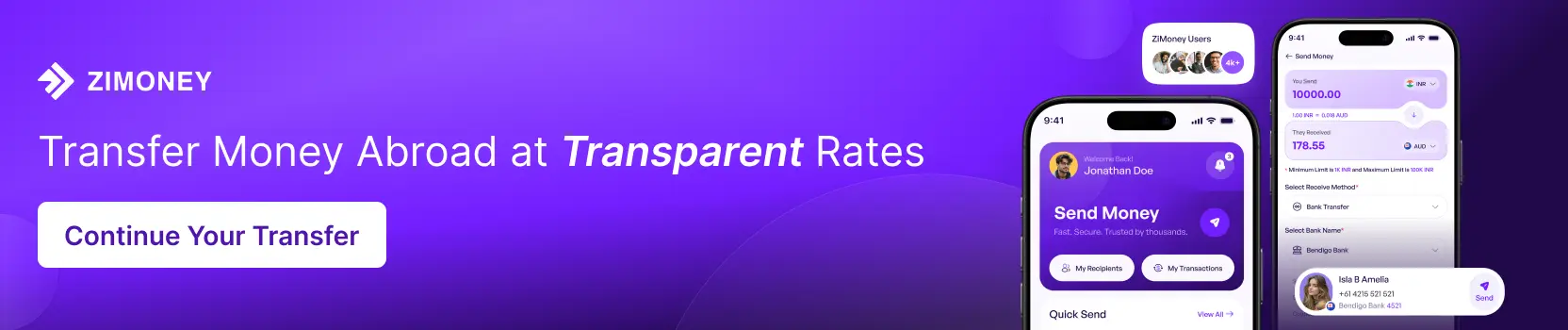
Customers using ZiMoney can view the full breakdown of their transfer before confirmation, including the exchange rate applied and the final payout amount. This visibility reduces uncertainty and supports informed decision making.
By maintaining structured compliance processes and working with established payout partners in supported corridors, ZiMoney aims to reduce reliance on complex intermediary banking systems. This approach enhances both predictability and cost efficiency.
Transparency is not simply a design choice. It is central to building long term trust within diaspora communities that rely on consistent remittance flows.
Read More:- ZiMoney and the Future of Remittances in Australia
Final Thoughts
International money transfer fees are often more complex than they appear at first glance. The visible service fee represents only one part of the overall cost. Exchange rate margins and intermediary deductions frequently have a greater impact on the final payout.
To avoid hidden charges, focus on the total amount your recipient will receive. Compare exchange rates carefully, confirm transparency before confirmation and choose a regulated provider with strong corridor expertise.
When supporting loved ones across borders, clarity matters. By understanding how pricing works and selecting a transparent platform, you can ensure that more of your money reaches its intended destination with confidence and security.